Touch as a Metaphysical Constraint of the Beautiful
Aristotle on why life requires material intimacy—and why abstraction alone can never realize the Beautiful.

Contemporary readings of De Anima tend to treat touch as a biological minimum condition for life, rather than as a metaphysical disclosure of how form remains bound to matter in actuality. This paper argues that this reduction obscures the explanatory role touch plays in Aristotle’s account of ensoulment. I proceed by first contrasting touch and sight, then examining ensoulment and form–matter unity, before turning to the axe example and finally to the implications for beauty and abstraction.
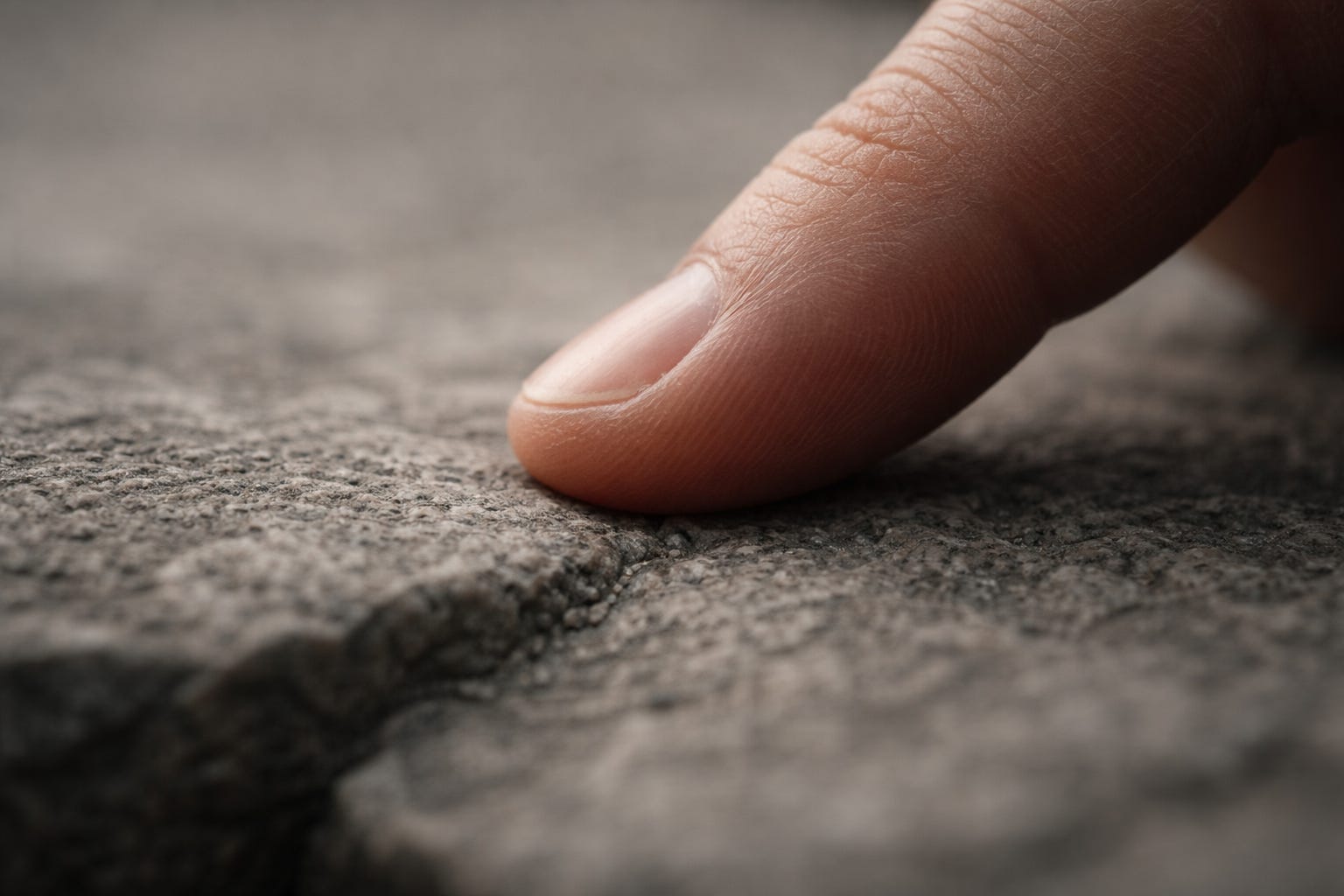
Aristotle spends a significant amount of time on the sense of touch (haphe) in De Anima—certainly more on this sense than on any other sense of the soul except sight. To clarify the distinction, sight is a sense known not by direct contact (thigganon), but rather one that requires a medium (μεταξύ) to carry the sensible form. By contrast, touch is the most intimate of the senses, requiring direct contact and clinging (ἅπτομαι) to a body. Without the capacity to sense by touch, there is no living body [De Anima III.10]. Earlier in De Anima, Aristotle notes that to be a living body with touch is to have desire (ὄρεξις).
This asymmetry between mediated and immediate sensing is not merely physiological but ontological, for it reveals the degree to which a living being is bound to its own material conditions of presence. To understand why touch bears this ontological weight, we must turn from sensation itself to Aristotle’s account of the ensouled body as the place where form and matter are not merely conjoined, but mutually determinative.
The body is present under its origin (ὑπάρξει), full of substantial being in nous (οὐσιώδης ἔννοια), that is, intelligible as a determinate form rather than a mere material aggregate [De Anima II.1]. This body is ensouled (ἐμψυχωμένος), possessing an origin of movement and rest, and the activities of life found in nourishment, growth, and decay [De Anima II.4]. This ensouled body is the unity of form (eidos) and matter (hylē). Aristotle names this unity morphē, a secondary sense of form that belongs not to abstraction but to living organization, one that manifests the particular entity’s telos (ἐντέλης πράγματος). Aristotle further discloses that matter is presence under the origin (ὑπάρξει), intimate (οἰκεῖα), and endowed with a fitting receptivity (καταλληλότητα τοῦ δέχεσθαι) to the substantial characteristics of a present body (ὑπάρξει οὐσιώδης ἔννοια). Because touch requires bodily co-presence, it resists the separation of form from matter that definition alone permits.
Other Aristotelian concepts—such as energeia or entelecheia—describe the actuality of a being once realized, but they do not themselves explain how form remains bound to matter in lived experience. Touch, by contrast, names the irreducible condition of bodily co-presence through which actuality is sustained at the level of life. Where much Aristotelian scholarship locates the explanatory center of actuality in energeia, I contend that touch names a primitive metaphysical constraint: the necessity of being materially receptive prior to any realized activity.
It is also true that nutrition and locomotion presuppose the unity of form, matter, and telos, but they do so only mediately and at the level of completed activity. Nutrition concerns the maintenance of the body once instantiated, and locomotion presupposes a determinate body already capable of self-movement. Touch, by contrast, is the condition under which a living being is materially affected as such. It does not merely express the unity of form and matter in action, but discloses it at the threshold of actuality itself, where a body must be capable of being acted upon and of acting in order to live at all. In this sense, touch uniquely exposes the inseparability of form, matter, and telos not as an achieved state, but as the ongoing condition of ensouled being.
Aristotle clarifies this unity not only through living bodies, but also through artifacts, where the limits of abstraction and definition become especially visible. This is why Aristotle notes that the ennoia of an axe, taken as substance alone (ousia autē), is the account (logos) stating that the axe is for the action (poiein) of chopping. Yet the activity of chopping is not the “soul” of the axe. To use only the name of the axe without a body is to present an ousia and a logos, but not the soul of the axe. What the axe example thus exposes is not merely a dependence on suitable matter, but the insufficiency of definition alone to secure actuality.
What follows is not an attribution of modern categories to Aristotle, but an extension of his metaphysical constraints into a contemporary understanding. While Aristotle does not frame this problem in terms of modern virtuality, his analysis nonetheless establishes a structural limit that invites contemporary extension. Read strictly within Aristotle’s framework, a name or definition remains insufficient for actuality insofar as it abstracts from the bodily conditions of form’s realization. Read diagnostically, this limitation anticipates what might now be described as the “virtual”—that which circulates without intimate co-presence. The virtual can be aggregated like a bundle of sticks, but not with the bond of intimacy found natural substantial body. To clarify this, Aristotle presents in the Physics two modes of necessity—hypothetical and material—using the example of a cutting instrument. The substance of the instrument is found in its telos, the activity of cutting, as its definition. Yet this remains a virtual object until it is intimate and clings (ἅπτομαι) to a morphē with matter that is fitting to the activity. For example, the reality of an axe’s power to cut would be hindered if the cutting part of the blade were made of wood rather than metal.
Aristotle himself often articulates the activity of thought in the mind through an analogy with sight and the body. Yet in De Anima, we find the thinker turn to the primal sense of touch to articulate the reality of soul. I would argue, by a heuristic parallel, that this emphasis on touch serves to safeguard the noetic activity of desire found in nature from the dangers posed by the virtual and fungible interchangeability of desire fostered by algorithmic spaces. Touch thus names the limit Aristotle places on abstraction itself. Without bodily intimacy, form loses its claim to presence under its origin, and desire loses its orientation toward living ends. We see the consequences of this safeguarding of abstraction by touch most clearly when we consider what the beautiful axe might be for Aristotle.
The excellence (aretē) of the axe in realizing its purpose (entelecheia) is an echo found in the resonant clarity of the place where a particular axe’s union with its matter best realizes the activity. A good axe enables the action proper to its essence. Yet virtue makes things good for the sake of the beautiful. If actuality requires such embodied completion, then the measure of a being’s excellence cannot be exhausted by function alone. The distinction between a good axe and a beautiful axe thus marks the difference between functional adequacy and completed actuality.
Thus, the beautiful axe is the axe with the right arrangement of schema, held in due measure between parts and whole, and between eidos and hylē, as found in this body. Finally, the beautiful axe exhibits a definiteness in which its form is fully realized in suitable matter [Metaphysics 1078a36]. In Aristotle, such completion does not remain internal to the object, but discloses itself as a mode of appearing within the world. In the beautiful axe’s presence and activity, the world rejoices.
Contemporary structures of exchange increasingly abstract desire from bodily presence, enclosing social life within regimes of fungibility that Aristotle’s account helps us diagnose as inhospitable to the beautiful. If touch marks the limit of abstraction, then its loss names not merely a cultural shift, but a metaphysical one. Read in this way, Aristotle’s account of touch reveals not a marginal physiological detail, but a metaphysical constraint on abstraction itself—one that binds life, desire, and beauty to embodied presence by fixing the point at which abstraction can no longer substitute for actuality.
Complete fire. Absolutely awesome. I loved this: ‘Read in this way, Aristotle’s account of touch reveals not a marginal physiological detail, but a metaphysical constraint on abstraction itself—one that binds life, desire, and beauty to embodied presence by fixing the point at which abstraction can no longer substitute for actuality.’ Perfect.